Who this worksheet is for
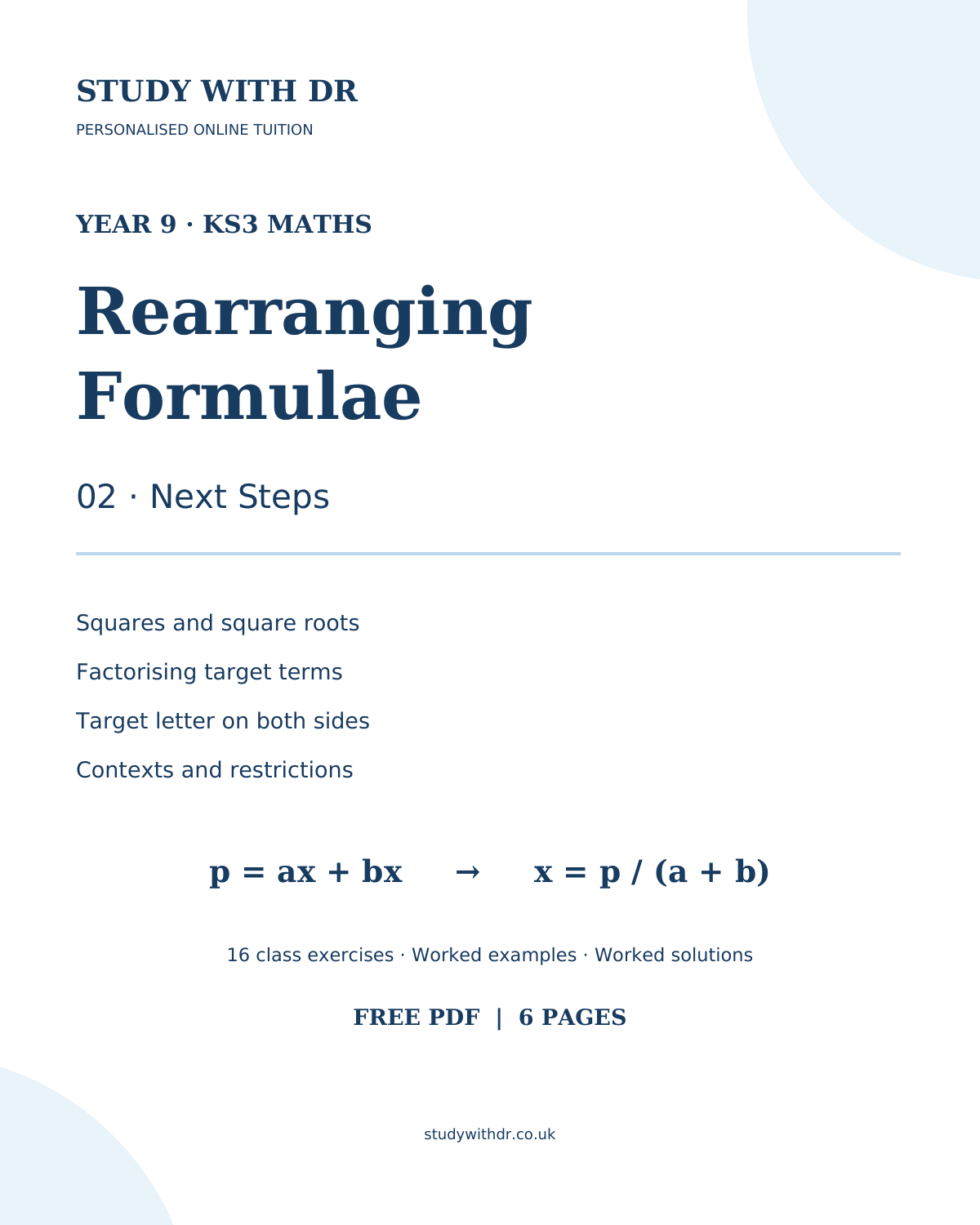
This handout is for Year 9 students ready to move beyond basic inverse operations, fractions and brackets. It extends changing-the-subject work to square roots, factorising and target-letter terms on both sides, with extension questions for additional challenge.
The four sections each contain a core concept, worked example and four class exercises, giving 16 exercises in total. The final two pages supply worked solutions and marking points. Foundations is the recommended starting point if the prerequisite skills need practice.
6 pages · 16 exercises · Worked solutions
What the worksheet covers
- Isolating squares before taking square roots
- Choosing positive roots for non-negative lengths and using ± roots in algebra
- Collecting and factorising target-letter terms
- Handling a target letter on both sides
- Non-zero denominators, restrictions and extension reasoning
- Applying rearrangement to circle area, rectangle perimeter and equal costs
Part 02 of a two-part Year 9 sequence, including stretch questions. Students should be comfortable with the Foundations techniques. This is a KS3 classroom resource, not an exam-board-specific GCSE worksheet; marking points are classroom guidance.
Key ideas at a glance
Isolate the square and choose the appropriate root
For A = πr² with r ≥ 0, r = √(A/π). For unrestricted real x with y = x², use x = ±√y when y ≥ 0; the two roots coincide when y = 0.
Factorise to isolate repeated target letters
For p = ax + bx + d, collect the x terms: p - d = x(a + b). Then x = (p - d)/(a + b), provided a + b ≠ 0.
Check restrictions before dividing
For ax + b = cx + d, x = (d - b)/(a - c) only when a ≠ c. If the target terms cancel, inspect the remaining equality rather than dividing by zero.
About the author
Dr Zhiying Xin is the founder of Study with Dr and a private Maths and Science tutor with nearly seven years of experience, teaching students from 11+ and GCSE through to A-Level and university. She completed her PhD at the University of Manchester.